Sadie Page
Chesapeake Bay Maritime Museum, Uncurated Search Results
Type: Bugeye
Year: 1889
Builder: J. L. Harrison
Location: Tilghman
These records are found in the collection of the Chesapeake Bay Maritime Museum in St. Michaels, Maryland. Uncurated search results are presented to give researchers and interested readers an idea of whether CBMM’s archives contain information about this vessel and whether it may be worthwhile to contact CBMM for further investigation. Uncurated results may be inaccurate or incomplete.
For more information about these items, contact the CBMM curator at collections@cbmm.org, or use the selection buttons below to submit a research request.
Search mode: Exact Name. Search phrase(s): "Sadie Page". Results returned: 4. Results displayed in this table: 4.
Use these buttons to send uncurated search results to your own app or text document for further research. First, check the box for any row, or click "Select All" then uncheck any rows. Then click "Show Selections". You can then copy your selections from the text box and past them into your app.
| Fetch? | Row ID | Catalog # | Object Name | Title | Artist/Maker | Date Made | Place Made | Description | Full Image | CBMM Cat. Page |
|---|---|---|---|---|---|---|---|---|---|---|
| 1 | 8888.0016.0000.00 | documents | Albert E. Brown and Bro Papers<CR><CR>The collection i | Brown, Albert __Creator | Exact 02/01/1988 - | Albert E. Brown and Bro Papers<CR><CR>The collection is comprised of some of the correspondence and business papers concerning the Brown's Sail Loft in Winona, Maryland. Included are many sail plans for work and recreational boats. These papers were retrieved by museum staff from the derelict sail loft with the permission of the owner. Many are damaged or, deteriorated.Biographical BackgroundAlbert E. Brown and Bro/ sail.1oft~:~was located at Wenona, on the southern tip of the island. The Loft was founded in 1870 by Capt. John Stubbs. In 1890 he was bought out by Henry Brown, born in England, and who served as a seaman in the Royal Navy. He learned the art of sailmaking when he came to the United States during the Civil War and joined the United States Navy.Henry constructed the present building. When he retired in 1919 his son Albert took over the sail loft. Albert's son Henry, in turn, started at the loft when he was 12 years old and took over the business in 1956. Henry G. Brown retired about 1980 and the building has stood empty ever since. In 1986 the old sail loft changed hands.In its heyday, the business was one-of the region's leading sailmakers and had a reputation for old-fashioned, quality workmanship. Orders for sails came from all across the country and from overseas.Scope and ContentThis material represents those papers that were salvagable and that remained in the sail loft after the business had closed. They give considerable insight into the operation of one of the country's most well-known sailmakers.The majority of the papers are correspondence written to the sail loft concerning orders for sails, frequently accompanied by a sail plan and an estimate. Of value are a number of sail plans for the oyster dredging fleet, that the loft kept on file for repeat orders, and letters concerning well-known Bay yachts. Many of these boats have long since disappeared. Sail Loft Amps (1923 - 1974)Brown Papers, p 2An index of boats is available.Correspondence was filed under boat name where it was known, and by correspondent's last name if-no specific boat was mentioned (except for one" design boats which are filed under class name).Other papers include"account books and miscellaneous business papers which provide an overview of 1"the finances of a traditional sailmaking business.Sub'ectsSailmaking Subject: Albert E. Brown and Bro. | No image URL. | View | ||
| 2 | 1994.0016.0001.00 | kitchen safes | Pie safe with schooners | 1830-1870 | Pie safe with schooner images punched into tin panels. 2 front doors, each with 3 vertical panels. Patina on all panels. Crisfield. Said to have come from an African-American household. Condition: good, wood worn on edges, LR two tin panels damaged. | 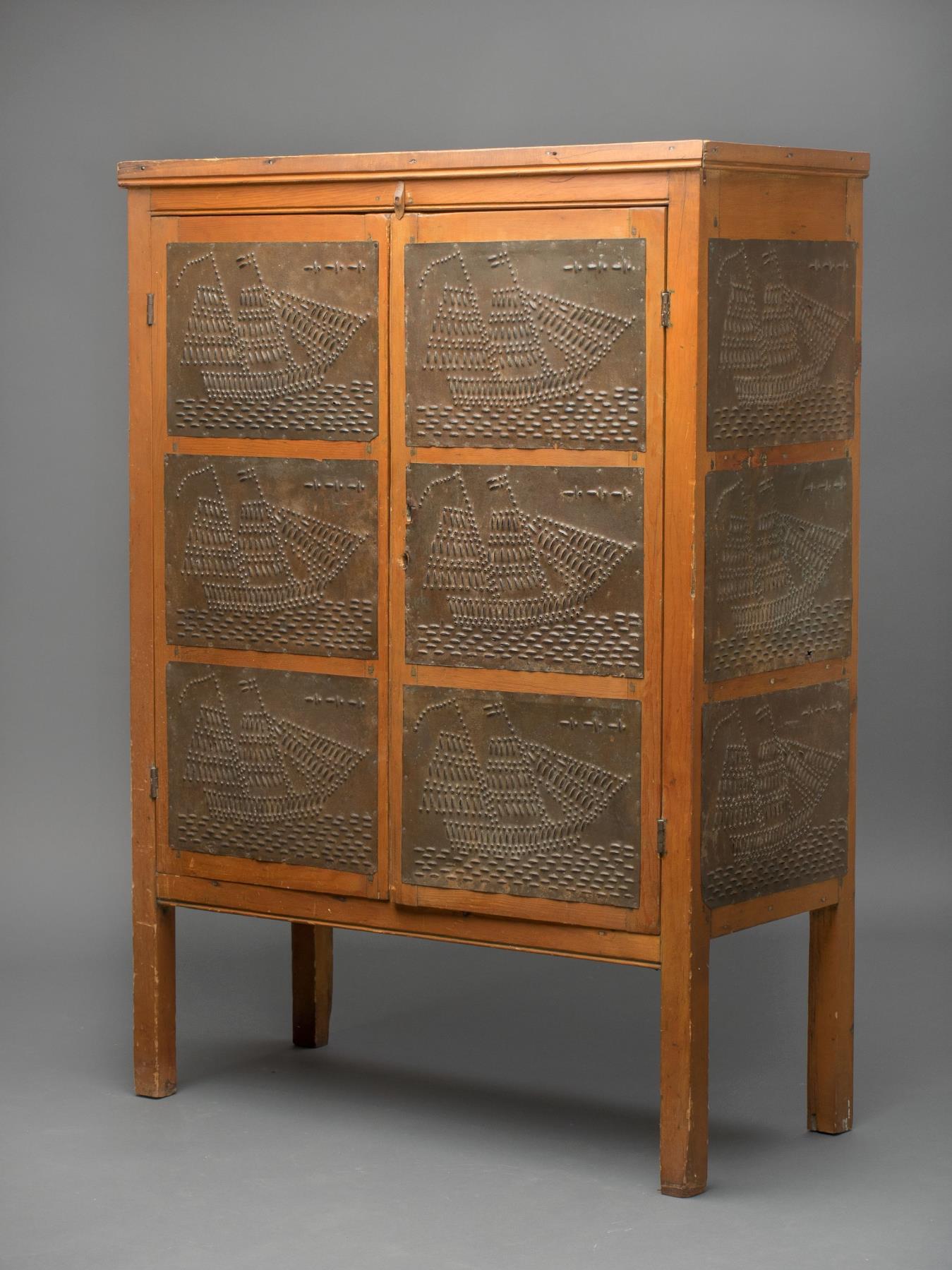 | View | |||
| 3 | 2003.0013.0001.01 | log canoes (model) | BELLE M. CRANE | Lambdin, Robert D __Creator | Circa 1930 | Log canoe model of the BELLE M. CRANE, but misspelled on bow "BELL M. CRAIN." Model has white topsides, red bottom, yellow cove stripe and bow sprit braces. Cotton sails, brown with age, two masts, jib boom, gull wing rig fore and main, one hiking board, and an oar, both in boat, cotton string for all lines, rudder, tiller. Interior painted an orange yellow; removeable chocks at both mast partners, centerboard pull, hatch cover over lazarette on skipper's seat. The model was built by Robert D. Lambdin (1849-1938) to represent the then-surviving log canoe, BELLE M. CRANE (built in 1879). Possibly made for owner of the canoe, Ruth Starr Rose, the only log canoe owner and skipper of her day. Model has cradle. Condition: Fair. Sails in disrepair, brown and holes: very fragile. Topside paint chipping. Cotton lines fragile. Sails located in CSA 7A2 | 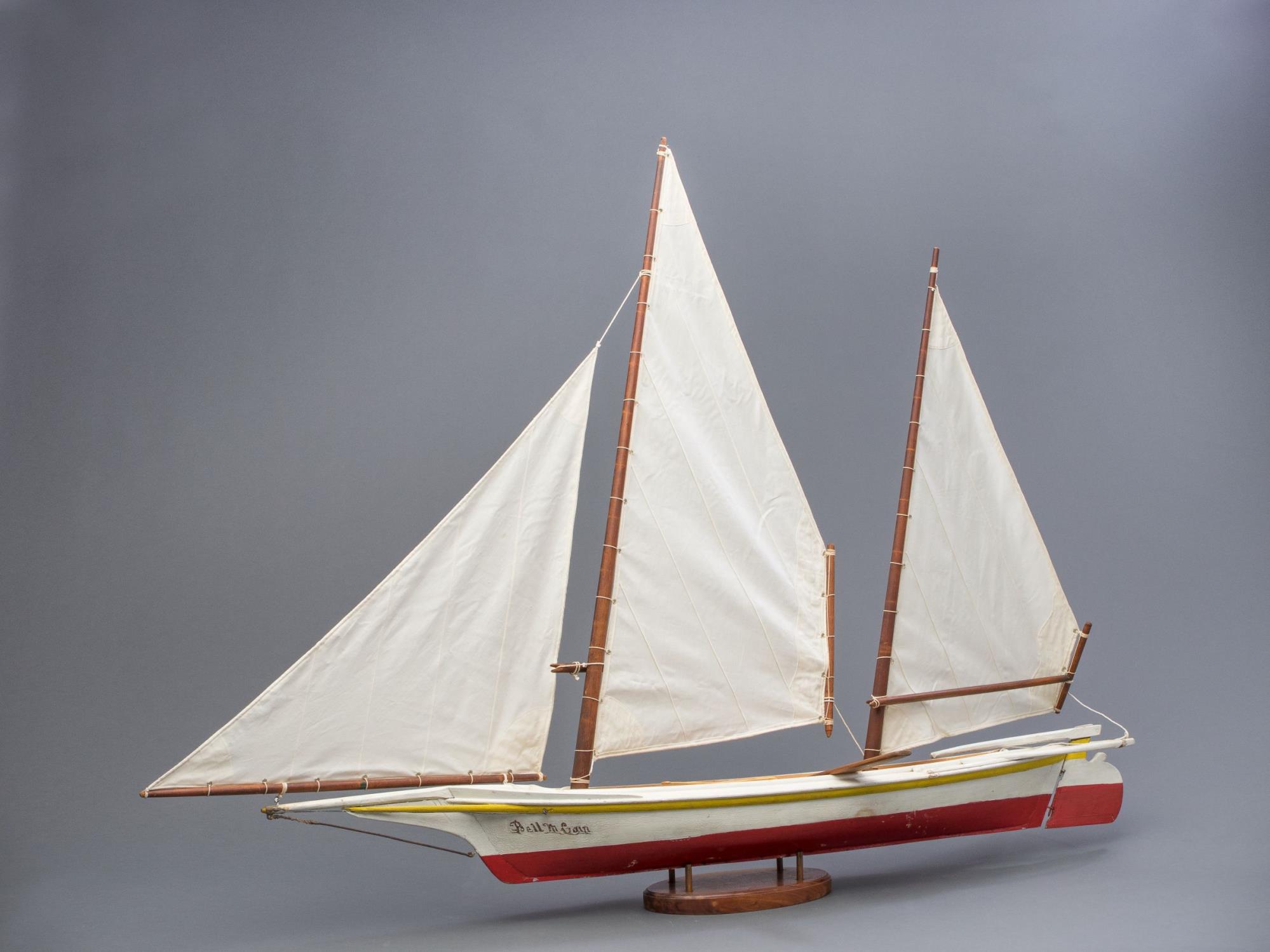 | View | ||
| 4 | 0000.1100 | photographs | Herman Hollerith, Jr. (1892-1976) Photo Collection | 1890-1970 | This is a collection of many photographs, which have not been cataloged individually. Please review the attachments for specific information on the images. <br /><br />Herman Hollerith, Jr. (1892-1976) Photo Collections (1890s--1970s) Biographical Background: Herman Hollerith, Jr. was born in 1892 at 3112 Q St., Georgetown, District of Columbia to Herman Hollerith, Sr. and Lucia Talcott Hollerith. His father invented the punch-card tabulating machine. He sold his company in 1911 to a firm that later became IBM. Other Hollerith children were Nan, Richard, Charles, Virginia and Lucia. The family lived in Georgetown, Garret Park and Montgomery County. In 1908 they bought a summer home in Mathews County, Virginia named Brighton. They spent their summers at Brighton from 1909. The family had a number of boats which were kept at Brighton: a New England dory named LUVINA; a flat bottomed power workboat named BRIGHTON; a 45 foot, gas powered yacht named REGINA, which was later renamed LUVINA and later still renamed MATOAKA, and an 85 foot vacht named LUVINA. The name Luvina was derived from the three daughter's names, Lucia, Virginia and Nan. Herman Hollerith, Jr. attended Worchester Polytechnic College with his borther, Charles, and received an engineering degree in 1917. He worked at the Naval Aircraft Factory in Philadelphia, and then at the Victor Talking Maching Company, where he was chief engineer and production engineer. During this time he lived in Riverton and Moorestown, New Jersey. He quit the Victor Talking Machine Company in 1928 when it was purchased by RCA. From 1932-1936 Hollerith was president of the Virginia Navigation Company and operated a small passenger steamer under contract to a large corporation. From 1936-39 he did not work during the Depression. In 1939 he moved to Baltimore to work for the Glenn L. Martin Company where he was involved in building airplanes during WWII. Hollerith worked until he was 69 years old. He was married twice. He and Sarah Valentine Fox had four children and were divorced in 1936. In 1938 he married Elisabeth C. Guest. In 1954 he bought a house near Oxford, Maryland and retired there in 1961. Hollerith was active in the early days ofnthe Chesapeake Bay Maritime Museum and was instrumental in the move of the Hooper Strait Lighthouse to the grounds. Hollerith had a love for boats and owned the ERIC, launched in 1925, until his death. This sailboat was an Atkins design based on a Norwegian ketch. ERIC was the prototype of the Westsai1 32. Hollerith died in 1976. For more information about the Hollerith family researchers should consult: HERMAN HOLLERITH: FORGOTTEN GIANT OF INFORMATION PROCESSING, by Geoffrey D. Austrian; NY: 1982, Columbia University Press. Scope and Content: This collection consists of photos taken or collected by Hollerith. The bulk of photos were taken by Hollerith of scenes from 1915-1940. They feature steamboat and sailboat scenes on the lower Chesapeake. Many of the photos were taken on cruises around Mathews County, Va. Some photos (especially M series negatives) were collected by Hollerith and taken by his father and brothers. The photos depict the agriculture life of the lower western shore and often show the introduction of power. Many of these photos have been published. The water was an important focus for life in Brighton. Mrs. Elisabeth Hollerith supplied a quote from Hollerith about life in Brighton: We did everything by boat, used the daily steamer from Norfolk for transportation to and from Washington and for most supplies including ice. Met the steamer at one of the wharves on the East River each day to pick up mail, visiting friends, etc. The roads were so bad we rarely went inland. Went to church and to visit our friends in a motor boat. In addition to the following subject indices, the researcher should note that Hollerith had his own subject indices. These are available to researchers and especially useful in looking for boat names. They are stored with the negatives. Subjects:Airplanes; Caribbean; C & D Canal; Eastern Shore; Hollerith, Herman, Jr.; Log canoes; Mathews county, Va.; Old Point Comfort, Va.; Sailboats, commercial; Seafood Industry; Steamboats, Chesapeake Bay; Washington, DC; workboats, Chesapeake Bay. Subject: Herman Hollerith Jr | 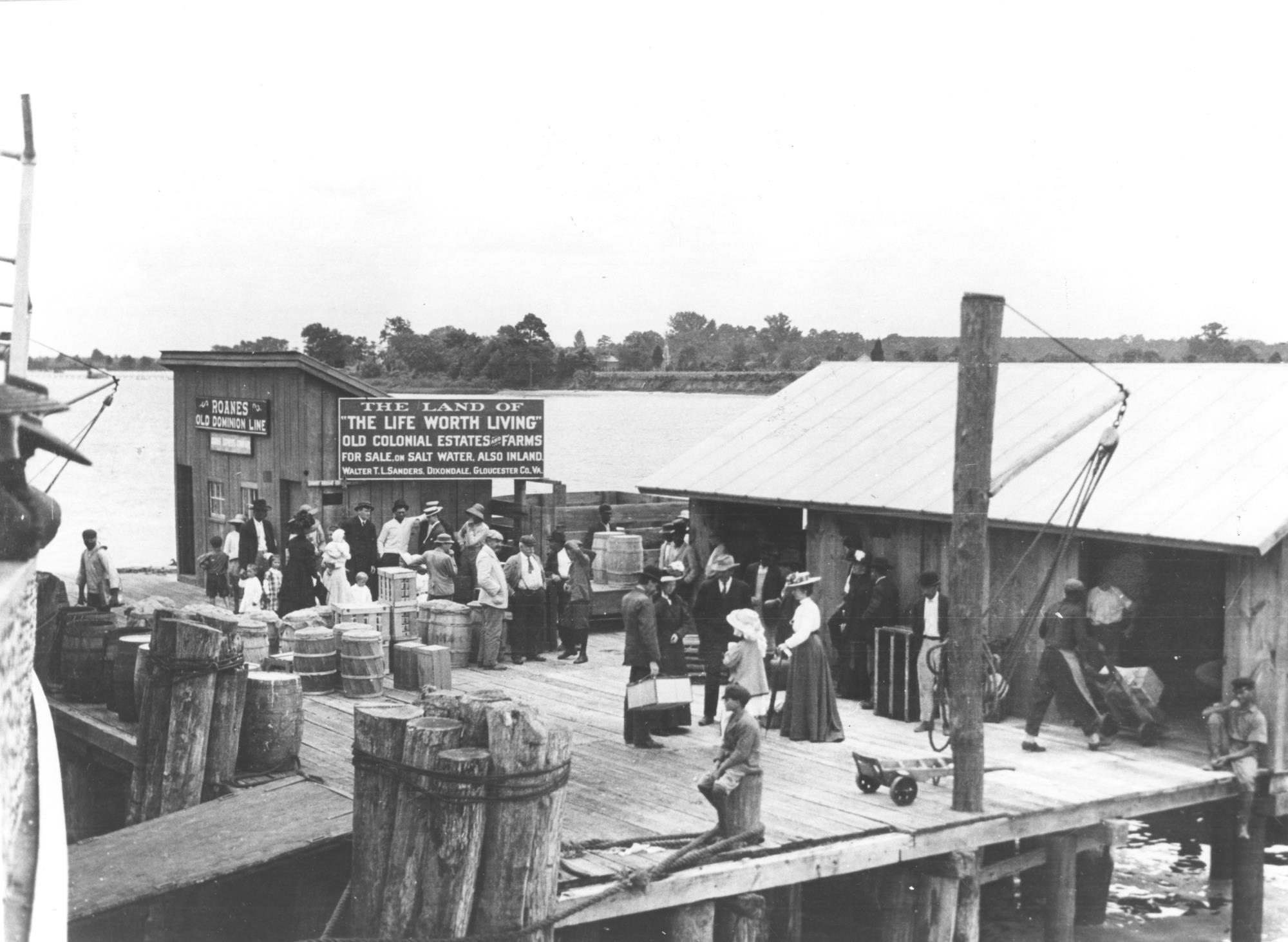 | View |
Created 2026 by Don Barker, CBMM volunteer, for the Chesapeake Shipbuilding Project. shipbuilding@sailingworkboats.es